
Why do backlinks still matter in 2026?

Backlinks still matter in 2026 because they remain one of the clearest ways a search engine can tell whether other people trust your content. Every link is a small vote of confidence from one site to another, and despite every algorithm update, Google still uses those votes — alongside content quality and user experience — to decide which pages deserve to rank.
That said, the role of links has evolved. Years ago, sheer link volume could power a site to the top of the results. Today, search engines weigh quality far more than quantity. A handful of editorial links from respected, relevant sites will beat thousands of low-quality links every time. Google's spam-detection systems have also become remarkably good at simply ignoring manipulative links, which means building bad links is not just risky — it is mostly a waste of effort.
Links also do something no algorithm update can take away: they send real visitors. A link on a popular article can drive a steady stream of qualified traffic for years, regardless of how it affects your rankings. This is why experienced SEOs evaluate every link opportunity on two tracks — the authority it passes and the audience it reaches. A link that delivers both is the gold standard.
If you are new to link building, it helps to see backlinks as relationships rather than transactions. Every quality link represents a real person or organization that found your content valuable enough to recommend. Sites that accumulate those recommendations naturally — by publishing genuinely useful content — build link profiles that survive every algorithm update. That is the mindset behind everything in this guide.
What are the core signals of a quality backlink?
No single factor decides a backlink's value. Search engines look at the link in context — where it comes from, where it sits on the page, what it says, and whether it looks like a genuine recommendation. The five signals below form the foundation; the rest of this guide goes deeper into each one and adds several more.
- Relevance — the linking site is topically related to yours. A link from a marketing blog to your SEO tool is valuable; a link from an unrelated casino site is not. Relevance is the single most important signal, and everything else matters less without it.
- Authority — the linking domain has real authority, built through its own quality content and links. One link from an authoritative site beats dozens from weak ones, but authority without relevance is far less powerful.
- Anchor text — descriptive, natural anchor text that tells searchers and search engines what the linked page is about. A varied, natural anchor profile beats repetitive exact-match anchors.
- Link attributes — a follow (dofollow) link passes authority. Nofollow, sponsored, and UGC links do not pass ranking weight the same way, but they still have value for traffic, branding, and a natural-looking link profile.
- Placement — a link inside the main content, where it genuinely helps the reader, is worth more than a link buried in a footer, sidebar, or author bio. Context and prominence on the page matter.
Why is relevance the most important signal?
Relevance is the most important backlink signal because a link only counts as a real endorsement when it makes sense in context. When a respected marketing blog links to your SEO tool, that recommendation is believable — the site's audience cares about SEO, and the link serves its readers. When an unrelated site links to you, there is no logical reason for the connection, and search engines treat it accordingly.
Think about it from Google's perspective. Its goal is to recommend pages that genuinely help searchers. A link from a site in your own niche signals that people who understand your topic consider your page worth recommending. A link from a random site with no topical connection carries no such meaning — at best it is neutral, at worst it looks like a paid placement or a link scheme.
Relevance works at several levels. The strongest links come from sites in your exact niche — an SEO blog linking to an SEO tool, for example. Next come adjacent niches: a web design blog linking to that same SEO tool still makes sense, because the audiences overlap. Links from completely unrelated topics — a recipe site linking to a tax calculator — are the weakest, and a profile full of them looks manipulated.
Page-level relevance matters too. A link from a relevant article on a general site can be more valuable than a link from the homepage of a barely-related one. When you evaluate a link opportunity, read the actual page that will host your link. Does the topic genuinely connect to yours? Would the page's readers benefit from clicking through? If you can answer yes to both, the link is relevant — and relevance is what makes authority count.
How much does the linking site's authority matter?
The linking site's authority matters a lot, but it is a multiplier on relevance — not a replacement for it. An authoritative site passes more ranking weight per link because it has earned Google's trust through its own quality content and backlinks. One link from a well-established, highly linked publication can do more for your rankings than dozens of links from obscure blogs nobody reads.
When people talk about authority, they usually mean third-party metrics like Domain Authority or Domain Rating — scores that estimate how likely a domain is to rank. These are useful shortcuts for comparing sites, but they are not Google metrics. Google does not use Domain Authority. A high score does not guarantee a powerful link, and a modest score does not mean a link is worthless, especially if the site is highly relevant and trusted within your niche.
Look beyond the score at what actually creates authority. Does the site publish original, well-researched content? Does it have its own strong backlink profile from reputable sources? Does it get real organic traffic? A small, focused industry publication with genuine readership and solid editorial standards can pass a more valuable link than a high-scoring general site that publishes thin content across hundreds of unrelated topics.
Also consider the linking page itself, not just the domain. A link from a page that already ranks well and has its own backlinks carries more weight than a link from an orphaned page nobody visits. Search engines evaluate the specific page hosting your link — its content, its own inbound links, and its position in the site's structure. Domain authority opens the door; page-level strength and relevance walk through it.
What is the difference between editorial and self-created links?

An editorial link is one that a site owner places voluntarily because your content genuinely deserved it — they found your research, tool, or article useful and chose to reference it. A self-created link is one you place yourself: a blog comment, a forum signature, a directory submission, or a profile link. Editorial links carry far more ranking weight because they represent an independent judgment of quality.
This distinction explains why some link-building tactics that used to work have faded. Blog comment links, forum profile links, and mass directory submissions are self-created, so search engines discount them heavily — they prove nothing about your content except that you know how to fill out a form. They are not necessarily harmful in small, natural quantities, but they will not move your rankings.
The most valuable links are the ones you cannot directly control. When a journalist cites your data, a blogger recommends your tool, or an industry site references your guide, that is an editorial endorsement — and search engines treat it as one. This is why the best link-building strategy is fundamentally a content strategy: create things worth linking to, then make sure the right people know they exist.
There is a middle ground worth understanding. Outreach-based links — where you email a site suggesting your resource — are self-initiated but still editorial if the site owner independently decides your content merits a link. The key test is independence: did the site choose to link because your content earned it, or because you paid for it, traded for it, or automated it? Only the first kind builds lasting value.
Does anchor text quality still matter?
Anchor text still matters because it tells search engines what the linked page is about. Descriptive anchor text — like "guide to checking keyword difficulty" linking to a keyword difficulty tool — helps Google understand the page's topic and can support its rankings for related terms. But the days of ranking through exact-match anchor manipulation are over, and overdoing it now is a liability.
A natural anchor profile is diverse. When real people link to your site unprompted, they use all kinds of anchors: your brand name, your bare URL, generic phrases like "this guide" or "click here," long descriptive sentences, and only occasionally an exact keyword phrase. If every link to your page uses the same commercial keyword as its anchor, the pattern looks engineered — and Google's algorithms are specifically tuned to spot it.
The healthiest approach is to not overthink individual anchors. Focus on earning links from relevant pages, and let the anchors fall where they may — that is what produces a natural distribution. If you are doing outreach and a site asks what anchor you would prefer, suggest something descriptive but varied, and never push the same phrase across multiple placements.
If your existing profile is already skewed toward exact-match anchors — a common legacy of old link-building campaigns — do not try to get those links changed or removed. That draws more attention to the pattern. Instead, earn new links with branded and generic anchors so the overall distribution gradually normalizes. Future diversity fixes past imbalance.
Does link placement really change a link's value?

Link placement genuinely changes a link's value. A link embedded in the main body of an article — surrounded by relevant text, where it helps the reader learn more — carries far more weight than the same link buried in a footer, sidebar, or author bio. Search engines give more weight to links that are prominent and contextually integrated, because those are the links real editors place for readers.
Position within the content matters too. A link near the top of an article, referenced as a key source, tends to carry slightly more weight than one dropped in a long list at the bottom. Links that stand alone as genuine recommendations outperform links stuffed into paragraphs of other outbound links. Context is everything: the fewer links competing for attention around yours, and the more topically connected the surrounding text, the stronger your link.
Template links deserve special caution. Footer and sidebar links that appear on every page of a site — "Designed by X" credits, blogroll links, sitewide sponsor badges — are repeated across hundreds or thousands of pages. Search engines recognize these patterns and heavily discount them; at scale they can look like a link scheme. A single in-content link from a site beats a sitewide footer link from the same site, every time.
When you evaluate a link opportunity, ask where the link will actually live. If it will be woven into the body of a relevant article, that is a strong placement. If it will sit in a footer, a sidebar widget, or an author bio box on a guest post, treat it as a weak link — acceptable for traffic or branding, but not a ranking driver. Placement is one of the fastest ways to separate good opportunities from mediocre ones.
What's the difference between dofollow, nofollow, sponsored, and UGC links?
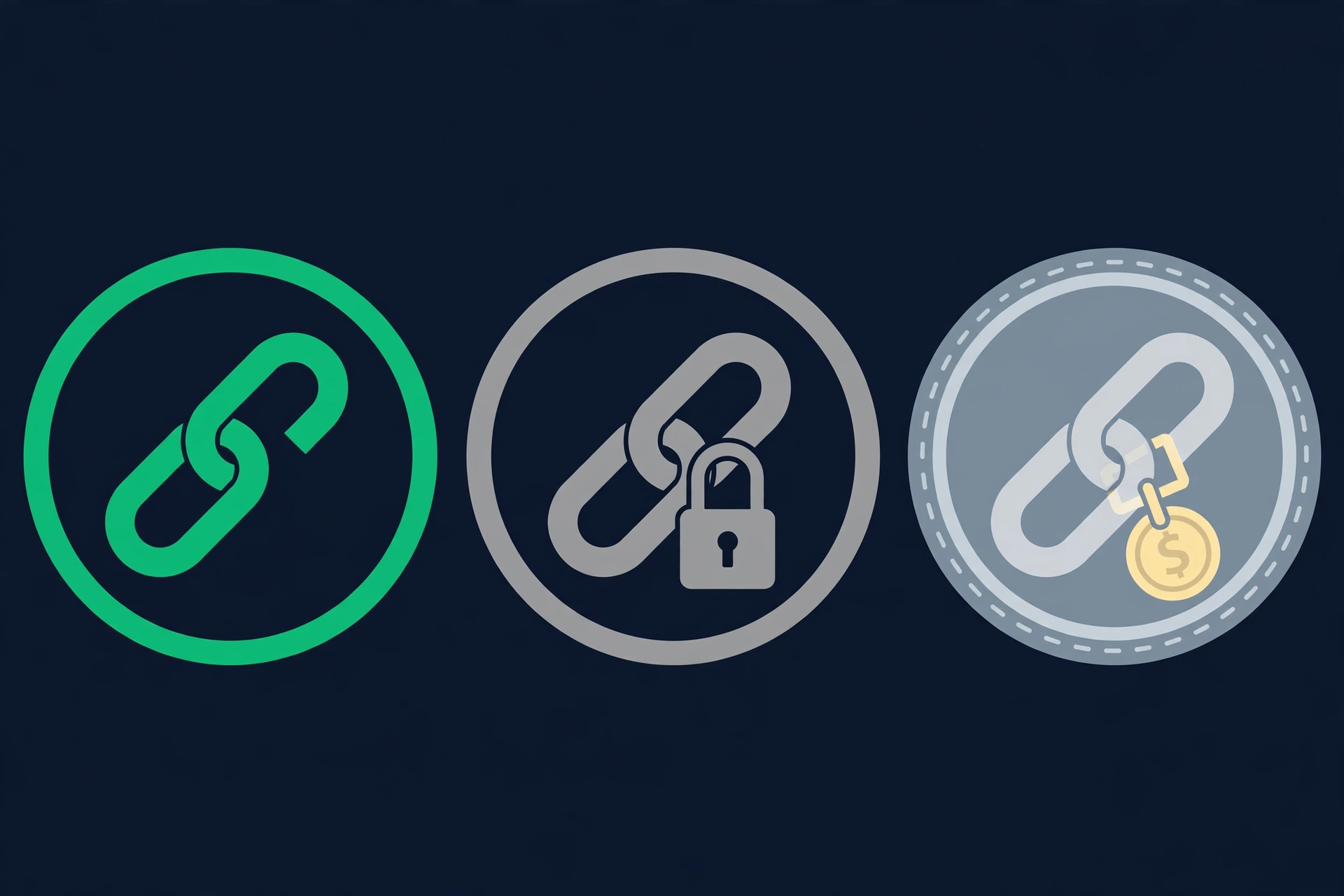
These four link attributes tell search engines how to treat a link. A dofollow link (a normal link with no special attribute) passes ranking authority and is what SEOs usually mean by a "good backlink." The other three — nofollow, sponsored, and UGC — do not pass ranking weight in the traditional sense, but each still has legitimate value in a natural link profile.
- Dofollow — the default. Passes ranking authority and is the primary driver of SEO value from links.
- Nofollow (rel="nofollow") — tells search engines not to pass ranking credit. Common on blog comments, forums, and social media. Still valuable for referral traffic and for making your overall link profile look natural.
- Sponsored (rel="sponsored") — identifies links that were paid for, such as advertisements and sponsored posts. Required by Google's guidelines for any paid link. Correctly attributed sponsored links keep you safe from penalties.
- UGC (rel="ugc") — marks links in user-generated content like comments and forum posts. Helps search engines understand the link was not editorially placed by the site owner.
A natural link profile contains a mix of all of these. Real sites attract nofollow links from social media, forums, and press mentions alongside their dofollow editorial links — a profile with 100% dofollow links looks manufactured. Do not turn down a nofollow link from a major publication or a high-traffic page; the referral visitors and brand exposure can outweigh the missing ranking credit.
One critical rule: any link you pay for must carry rel="sponsored" or rel="nofollow". Paid dofollow links violate Google's link spam policies and are one of the clearest triggers for a manual penalty. If a site offers to sell you a dofollow link, walk away — the short-term gain is never worth the risk, and Google actively hunts these arrangements from both the buyer and seller side.
Does the traffic value of the linking page matter?
Yes — the traffic value of the linking page matters more than most link builders admit. A link on a page that real people actually visit can send you a steady stream of qualified visitors for years, and that referral traffic converts: these visitors arrive pre-qualified, already interested in your topic, and already trusting the site that recommended you.
Traffic is also a quality filter. A page that ranks well and draws organic visitors has proven itself to Google — it is indexed, trusted, and topically relevant. Links from such pages tend to carry more ranking weight than links from pages nobody visits, partly because search engines weight links from pages they themselves trust and crawl frequently. When a page gets no traffic and has no inbound links of its own, ask why anyone's link there would matter.
This is why chasing links on high-traffic resource pages, popular roundups, and well-read industry blogs pays double: you get the SEO value and the visitors. Before pursuing a link, check whether the target page actually ranks for anything or receives traffic. A link on a dead page of a high-authority domain is better than nothing, but a link on a living, trafficked page is in a different league.
Think of every link as having two values that multiply: authority value (what it does for rankings) and audience value (what it does for your business directly). The best link opportunities score well on both. A link from a niche blog with a loyal readership may pass modest authority but drive customers for years — and over time, those visitors share your content and create second-order links, compounding the original win.
How can you earn good backlinks?

The most sustainable way to earn quality backlinks is to create content worth linking to, then make sure the right people know it exists. Link earning — sometimes called link attraction — beats link begging because the link is a genuine editorial decision. Four strategies consistently produce the best results: original research, useful tools, digital PR, and broken link building.
Original research is the single most link-worthy content type. Surveys, industry studies, and data analyses give journalists and bloggers something they cannot get anywhere else: a citable statistic. When your study becomes the source for a widely quoted number, every article that cites it links back to you. You do not need a massive budget — a well-designed survey of a few hundred professionals in your niche, published with clear charts, can earn dozens of editorial links.
Free tools earn links on autopilot. A genuinely useful free tool — a rank checker, a calculator, a template generator — gives other sites a reason to reference you whenever the topic comes up. Resource pages, "best free tools" roundups, and tutorial articles link to tools naturally and repeatedly. The RankSEOTool tools themselves are designed to be useful and link-worthy: a free SEO Rank Checker or On-Page SEO Score Checker gives people a reason to reference your site naturally.
Digital PR and journalist outreach work when you have something newsworthy: data, a contrarian finding, or a timely angle on a trending story. Services that connect journalists with expert sources let you earn links from major publications by providing genuine expertise — a quote in a national news article is one of the highest-authority links you can earn. The key is relevance: only pitch stories where your expertise genuinely fits, and respond fast with substance, not fluff.
Broken link building is the most beginner-friendly outreach tactic. Find resource pages in your niche, check them for dead outbound links with the Link Profile & Broken Link Checker, and email the site owner: their page has a broken link, and your content is a suitable replacement. You are doing them a favor — fixing their page — which is why response rates are far higher than cold "please link to me" emails.
Whatever tactic you choose, the outreach itself must be genuine and personal. Mass templated emails asking for links have terrible response rates and can damage your reputation. Write to real people about why your content specifically helps their audience, keep it short, and follow up once — politely. One thoughtful email beats a hundred blasts.
Which bad backlinks should you avoid?

Just as important as earning good links is knowing what to avoid. Bad backlinks come in two flavors: links that simply do nothing, and links that actively endanger your site. The first kind wastes your time and money; the second can trigger a Google penalty that wipes out your rankings. Here is what to stay away from:
- Link farms — networks of low-quality sites built solely to sell links. Their pages exist for no reader, and Google devalues them aggressively.
- Private blog networks (PBNs) — groups of sites controlled by one owner, built to simulate independent editorial links. Google actively hunts PBNs; when one is caught, every site it links to can be penalized.
- Paid links without proper attribution — buying dofollow links violates Google's link spam policies. Paid links must carry rel="sponsored" or rel="nofollow".
- Spammy directories and bookmark sites — bulk submissions to hundreds of low-quality directories do nothing for rankings and can pollute your profile.
- Unrelated sites with no topical connection — a sudden influx of links from irrelevant sites looks manipulated, not earned.
- Sitewide footer and sidebar links — repeated across hundreds of pages on one domain, these look like template manipulation rather than endorsement.
- Automated comment and forum spam — self-created links at scale add zero authority and can associate your domain with spam neighborhoods.
- Hacked or injected links — links placed on compromised sites without the owner's knowledge. If you discover these pointing at you, disavow them.
Google can penalize sites that engage in manipulative link schemes — see Google's link spam policies for what to avoid. The risk is not worth the short-term gain. Penalties can take months to recover from even after you clean up, and lost rankings mean lost revenue the entire time.
Be especially skeptical of anyone selling "guaranteed" links or "high DA backlinks" packages. Legitimate editorial links cannot be guaranteed — no one can promise that an independent site will link to you. What these sellers actually deliver is placements on PBNs, link farms, or hacked sites: exactly the links that put you at risk. If a link-building offer sounds too easy, it is.
How to audit your existing backlinks
Before building new links, understand what you already have. Use the Link Profile & Broken Link Checker to audit the outbound links on your pages — it flags suspicious destinations, broken links, and anchor-text issues. For incoming backlinks, review the Links report in Google Search Console and a dedicated link index to see which domains link to you and assess their quality.
When auditing, focus on the patterns, not individual links. Count your referring domains — unique linking sites — rather than total links, because domains are what Google weighs most. Check your anchor text distribution for over-optimization, scan for links from irrelevant or spammy neighborhoods, and note which of your pages attract the most links so you can create more content like them. If you find toxic links you cannot get removed, Google's disavow tool is a last resort — use it sparingly, because disavowing good links by mistake hurts you.
How do you evaluate a link opportunity? A practical checklist
Before you invest time pursuing any link, run it through this checklist. A link does not need a perfect score on every item — but the more boxes it checks, the more confident you can be that it is worth your effort.
- Relevance — is the site (and the specific page) topically related to yours? Would its readers genuinely benefit from your content?
- Real audience — does the site publish for actual readers, with original content, real traffic, and engagement? Or does it exist only to host links?
- Authority signals — does the domain have its own quality backlinks, ranking pages, and a history of trustworthy content?
- Editorial standards — would the site link to you on merit, or is the placement paid, automated, or reciprocal? Editorial beats everything.
- Placement — will the link sit in the main content, or in a footer, sidebar, or bio box? In-content links carry the real weight.
- Link attributes — will it be dofollow? A nofollow link from a great site is still worth having, but know what you are getting.
- Traffic potential — does the linking page rank or get visited? A link that sends real visitors pays off even before rankings move.
- Anchor text — will the anchor be natural and varied, or forced and exact-match? Natural wins.
- Neighborhood — what other sites does the page link to? If it links to spammy or irrelevant sites, stay away.
- Indexation — is the page actually indexed by Google? A link on a page Google never crawls passes nothing.
Keep this checklist somewhere visible and use it consistently, especially if anyone else builds links for you. It takes two minutes per opportunity and prevents the single most common link-building mistake: spending weeks chasing links that were never worth having. When in doubt, compare the opportunity against your best existing links — if it is clearly weaker than what you already earn naturally, skip it.
You can also use this checklist in reverse to evaluate your competitors. Run a competitor's domain through the Competitor Rank Checker to see where they stand, then examine which sites link to their best content. The link opportunities behind their strongest pages — resource pages, roundups, industry publications — are usually available to you too, if your content is genuinely competitive.
Quality over quantity

Twenty links from twenty different relevant, authoritative domains are worth far more than two hundred links from a single low-quality domain. Focus on earning a diverse set of high-quality links rather than chasing volume. A clean, relevant link profile is a long-term asset; a spammy one is a liability.
This principle should guide every link-building decision you make. When choosing between ten easy directory submissions and one well-researched outreach email to a respected publication, choose the email. When deciding whether to pursue a link, ask whether it would still be worth having if search engines did not exist — would the traffic, the audience, and the association still benefit your business? Links that pass that test are the ones that also survive every algorithm update.
Building a quality link profile is slow work, and that is exactly why it works. Every editorial link you earn is a durable competitive advantage that competitors cannot copy overnight. Start with the checklist above, invest in content worth linking to, and measure progress in referring domains from relevant sites — not raw link counts. That is what makes a good backlink profile, and it is what this entire guide has been building toward.